Apartment Hunting Checklist for Newcomers to Austin
Moving to Austin? Follow this step-by-step apartment hunting checklist — budget, documents, neighborhoods, tours — and skip the rookie mistakes.

We consistently see incoming residents underestimate the speed of the local rental market. The environment here shifts rapidly. A massive wave of 30,000 new units hit the city in the last year, pushing the vacancy rate near 13.8% for 2026.
Our team knows this specific supply spike hands renters incredible negotiating power. The median rent sits around $2,533 per month as of mid-2026.
Smart applicants use these market conditions to secure valuable lease concessions.
We built the exact apartment hunting checklist Austin newcomers use to gain a clear advantage. This guide covers the timeline, budget math, and neighborhood facts required for a successful moving to Austin apartment transition.
The Timeline: Apartment Hunting Checklist Austin
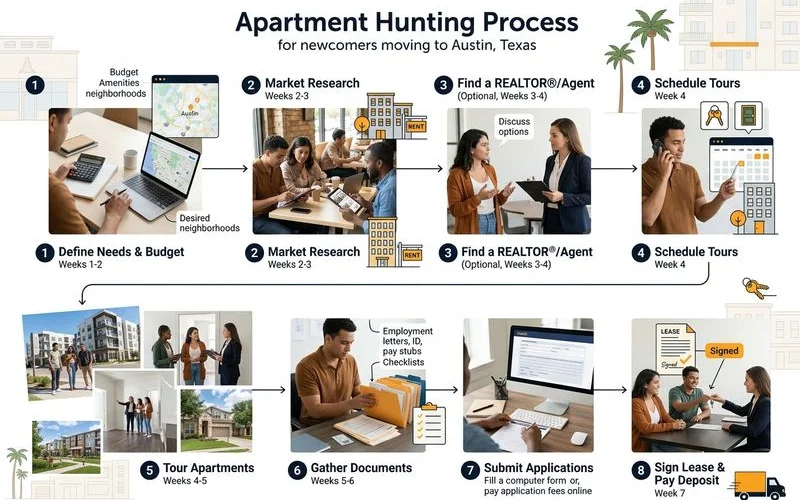
We suggest rethinking your moving schedule when heading to Texas. The busiest leasing season spans June, July, and August. Properties process applications incredibly fast during these peak summer months.
Our professional service team recommends starting your search six weeks out if you need a summer move-in. This buffer provides room for multiple application rounds if necessary. You can shrink that timeline to four weeks during the cooler months.
We organize the ideal schedule into three distinct phases. A clear plan prevents last-minute panic.
| Timeline Phase | Key Actions to Take |
|---|---|
| 6 Weeks Out (Summer) | Set a firm budget, select 3 target neighborhoods, and digitize all application documents. |
| 2-3 Weeks Out | Hire a local locator, complete virtual tours, and submit final applications. |
| Move-In Week | Finalize Austin Energy setup, activate internet, and complete the unit walkthrough. |
Our locators see too many people wait until the last minute to book movers. Local moving companies book up weeks in advance during July and August.
Setting Your Budget (the 3x Rule)
We always remind renters that the listed price is only the starting point. The true cost of living requires a closer look at mandatory fees. Most properties strictly enforce a 3x-income requirement.
Our leasing partners expect your gross monthly income to equal three times the monthly rent. A unit priced at the $2,533 median requires a monthly gross income of roughly $7,600. Management companies calculate this number before taxes.
We occasionally see strict luxury buildings require 3.5x income. Second-chance properties might drop to 2.5x if you provide a guarantor or pay a larger deposit.
Calculating Hidden Fees
We advise clients to budget for the extra expenses that property managers add to the base rent. These mandatory charges quickly inflate your monthly payment. You must account for parking, pet rent, and valet trash services.
Our data shows these fees add $100 to $250 per month on top of the advertised price. Many buildings also charge setup fees for administrative tasks.
- Utility Fees: Expect separate charges for water and common-area electricity.
- Valet Trash: Usually a mandatory $25 to $35 monthly charge.
- Pet Rent: Buildings typically charge $15 to $25 per pet, plus a hefty upfront deposit.
- Parking Permits: Garage spots often cost $50 to $150 extra per month.
We suggest asking for a complete fee sheet before applying. Knowing the exact total helps you compare different buildings accurately.
Documents to Have Ready
We strongly suggest compiling a digital folder of your paperwork before touring. Speed wins the day in this competitive housing landscape. Property management software systems like Yardi and RealPage process applications instantly.
Our experience shows that managers hold units for the very first qualified applicant who submits a complete file. Missing a single pay stub can cost you the perfect apartment.
- Government ID: A driver’s license or passport. Your out-of-state license works fine.
- Proof of Income: Your last two pay stubs or two years of tax returns for self-employed workers.
- Employment Verification: An official letter from HR confirming your start date and salary.
- Financial History: Two full months of bank statements.
- Pet Records: Vet history, a clear photo, and breed information. Many buildings strictly ban certain dog breeds or cap weights at 50 pounds.
We always tell out-of-state workers to get that employer letter signed early. Offer letters usually satisfy the income requirement if you are relocating for a new role. A delay from your HR department is a common roadblock.
Choosing a Neighborhood
We understand that picking the right zip code feels overwhelming from a distance. The neighborhoods here vary dramatically in cost, culture, and convenience. A quick look at the map does not reveal the reality of daily traffic.
Our team relies on recent 2025 traffic data showing that local commuters lose over 50 hours a year to delays. Morning congestion on I-35 and MoPac Expressway peaks heavily between 7:05 AM and 8:45 AM. You must factor this reality into your housing decision.
Consider this section your mini Austin relocation apartment guide. Here is the high-level shorthand. For the full breakdown, read our comprehensive best Austin neighborhoods for renters guide.
- Downtown / Rainey Street: Walkable high-rises with expensive rents. Perfect for short urban commutes.
- East Austin / Riverside: Character-heavy areas featuring live music venues and mixed price points.
- Mueller / North Loop: A strong neighborhood feel with excellent access to the MoPac commute.
- South Congress / Bouldin: Premium restaurants and high weekend energy with top-tier pricing.
- The Domain / North Austin: Newer master-planned communities close to the northern tech corridor.
- Suburbs (Round Rock, Pflugerville): More square footage and lower rent, traded for a much longer drive.
We suggest picking a maximum of three areas to focus your search. Touring properties across the entire metro wastes valuable time. Focus on locations that keep your daily drive under thirty minutes.
Touring Remotely
We manage virtual property tours for dozens of relocators every month. Most incoming residents sign a lease without ever stepping foot inside the building. This is a completely normal practice in this market.
Our agents use a specific strategy to ensure you get exactly what you expect. You need reliable eyes on the ground.
The Remote Tour Playbook
- Hire a local locator: They walk through the property, record live video, and answer your questions in real-time.
- Request current video walkthroughs: Leasing offices will gladly send you a personalized video from a smartphone.
- Inspect the exact unit: Professionally staged models hide flaws. Demand to see the specific apartment you will rent.
- Verify the orientation: Check which direction the windows face to gauge natural light and street noise.
We warn clients against flying down without a solid plan. A weekend trip should focus purely on your top three shortlisted properties. Do not spend an expensive trip simply exploring different neighborhoods.
The Newcomer’s Biggest Mistakes
We consistently see new residents stumble over the same logistical hurdles. A little preparation easily prevents these frustrating and costly errors. The local landscape requires attention to a few unique administrative details.
Our team built this warning list to keep your transition as smooth as possible. Pay close attention to utilities and insurance.
- Trusting listing-site rents: Prices on Zillow or Apartments.com are often weeks out of date. Always call the leasing office to confirm the current daily rate.
- Underestimating utility setup: Austin Energy handles power and water for most of the city. Their online portal takes ten minutes, but phone wait times can hit 45 minutes during peak moving weeks. Submit your request 5 to 7 days before move-in.
- Skipping renter’s insurance: Texas properties almost universally require an active policy. A standard policy costs an average of $22 per month in 2026. Request replacement cost coverage instead of actual cash value.
- Ignoring internet contracts: Many newer buildings sign exclusive deals with providers like Spectrum or Grande. You might not have the option to install AT&T Fiber.
- Failing to test the commute: Weekend traffic feels light. Test your route on a map application at 5:00 PM on a Tuesday to see the true travel time.
We handle the heavy lifting for renters who want to skip the stress entirely. Using an apartment hunting checklist Austin style means anticipating these local quirks.
That is exactly what professional apartment locators do.
Tell us your move-in timing and we will line up a curated shortlist before you even book your flight.
Common Questions
Quick answers on the apartment hunting checklist for newcomers to austin.
How early should I start apartment hunting before moving to Austin?
+
Can I tour Austin apartments remotely?
+
What documents do I need ready as a newcomer?
+
Related Guides
Best Austin Neighborhoods for Renters: A Commute & Lifestyle Guide
Downtown, East Austin, Mueller, North Loop, The Domain and more — compare Austin rental neighborhoods by commute, vibe, and price to find your fit.
What Documents You Need to Apply for an Austin Apartment
Proof of income, pay stubs, bank statements, ID, rental history — here's the full document checklist to apply for an Austin apartment and avoid delays.
Finding Luxury & High-End Apartments in Austin Without the Legwork
Want a high-end Austin apartment without the searching? See how our free locating service surfaces luxury units, move-in specials, and off-market deals.
Ready to start your free Austin apartment search?
Tell us your situation. We'll match you only with properties that approve renters like you, free of charge.
Same-day tours • 7 days a week • 100% free for renters