Eviction-Friendly Apartments in Austin
A prior eviction doesn't have to block you. See how Austin properties treat eviction filings vs judgments and how we pre-qualify you for ones that approve.

We understand the stress of securing immediate housing as a newcomer to Texas. Searching for eviction friendly apartments Austin residents recommend can feel impossible, since a court flag triggers automatic application denials faster than almost any other screening factor.
Our professional service team tracks exactly which local properties have shifted toward case-by-case reviews. You have real paths to approval if a recent denial has stalled your apartment hunt.
We will break down how local managers evaluate court records, what data they see, and the specific steps required to get your application approved this week.
Filings vs Judgments
This distinction matters deeply, as courts treat a filing very differently than a final judgment. We often see applicants denied because of a dismissed case they thought was off their record. Most renters do not realize that a simple paperwork submission can stall their move to a new neighborhood.
| Record Type | Legal Meaning | Impact on Screening |
|---|---|---|
| Eviction Filing | Landlord submitted paperwork to a Justice of the Peace. | Triggers many automated declines, even if dismissed. |
| Eviction Judgment | The court ruled in favor of the property owner. | The most severe flag, usually accompanied by a money judgment. |
The volume of these records is increasing across the city. Our local tenant groups, like BASTA, report that the typical time from a filing to a forced move-out in Austin is a mere 20 days. Travis County recorded 13,209 eviction filings in 2024, marking a 25% jump from the previous year. You must act incredibly fast if you receive a notice to vacate.
Most properties screen for both filings and judgments, treating them distinctly during manual reviews. We advise clients to secure proof of dismissal immediately if they paid their balance or moved out before the court date. A dismissed filing is much easier to explain than a judgment with money owed.
The exact terminology your screening report uses will vary based on the provider:
- Filed: Paperwork submitted, with no ruling yet.
- Dismissed: Case dropped or settled before a judge ruled.
- Judgment for plaintiff: Court ruled for the landlord, often creating a financial debt.
- Outstanding eviction filings: Multiple recent filings appear on your background check.
Recency: the Number One Factor
Time elapsed since the court date drives approval odds more than any other single factor. We track approval rates daily and see a clear pattern emerge based on the age of the eviction. Property managers view an older record as a much lower risk than a recent judgment.
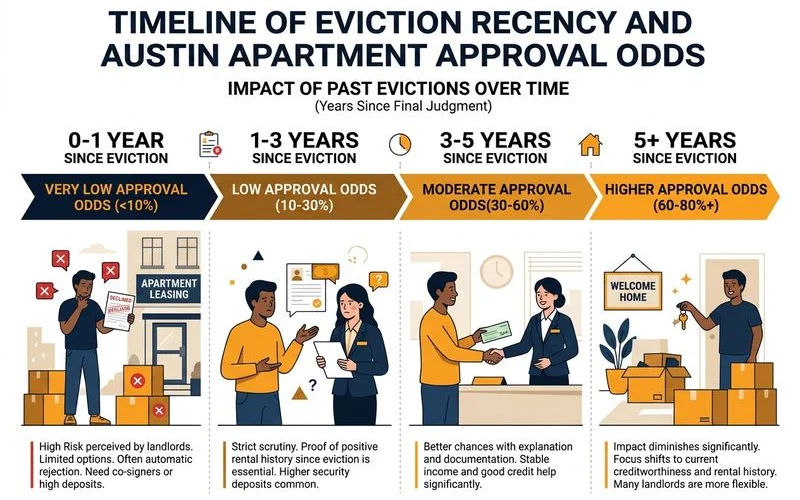
The age of your case dictates which apartments that accept evictions Austin has available will even consider your application. Our placement data reveals the following timeline for local properties:
- Within 12 months: The hardest timeframe for approval. Most properties will decline your application immediately. Some second-chance specialists will review your file if you have strong income and a paid balance.
- 1 to 3 years: A moderate challenge. A meaningful share of case-by-case properties review applications that include a paid ledger and a written explanation.
- 3 to 5 years: Considerably easier. Most second-chance properties will review your history, and many standard properties transition to a case-by-case approach.
- 5+ years: Many properties drop the heavy weighting of the eviction entirely, especially if you show a clean rental history since the event.
- 7+ years: Consumer protection laws dictate that tenant screening databases stop reporting the eviction entirely after seven years.
This framework is a proven guide rather than a hard legal rule. We base this pattern on hundreds of successful placements across Central Texas. You can still secure a great apartment near major transit lines if you target the correct age bracket for your specific record.
What Case-By-Case Properties Want to See
Managers want to see proof of financial recovery before they approve a file with a complicated history. We guide applicants to prepare a specific set of compensating factors before submitting any non-refundable application fees. They need documented evidence that the previous issue is fully resolved.
The standard request from an accommodating property manager includes specific paperwork:
- Paid balance: You must get the balance paid or settled if you owed money from the court judgment. A paid-in-full letter from the previous property is your single highest-leverage document.
- Landlord explanation letter: Write one page in your own voice explaining the situation. See our landlord explanation letter template for the correct professional structure.
- Strong income: Properties typically demand 3x to 3.5x the monthly rent. The average Austin rent currently sits around $1,530, meaning you need to prove a gross monthly income of roughly $4,590 to qualify for a standard one-bedroom unit.
- Clean recent rental history: Managers look for two to three years of on-time rent payments since the court filing.
- Larger deposit: Expect to pay an increased security deposit or a non-refundable risk-mitigation fee if the property extends an offer.
Properties that automatically decline an eviction flag will never change their mind, regardless of the compensating factors you offer. We constantly see renters waste hundreds of dollars on application fees by targeting these strict buildings. Targeting the right properties gets you approved quickly, keeping your commute times short and your budget intact.
How Property Managers Screen for Evictions
Most Austin properties utilize automated third-party software to screen incoming applications. We know from experience that these algorithms completely ignore personal context or letters of explanation. These systems assign a rigid numerical score based on your background data.
The most common screening tools used in the local market include a few major platforms:
- SafeRent: An automated screening system that scores income, credit, criminal, and eviction history into a single metric.
- Credit Retriever: A similar automated platform that pulls public court records and credit files.
- RentGrow: A broader database containing specific rental industry data and ledger histories.
- Manual landlord verification: A leasing agent calls your prior landlord directly to discuss your tenancy.
The Problem With Automated Systems
Automated systems severely hurt applicants with complex histories. Our team avoids sending clients to buildings that rely strictly on AI software. A 2022 federal lawsuit against SafeRent showed how their proprietary algorithm automatically lowered scores for applicants using housing vouchers.
The software simply cannot weigh individual circumstances or read a hardship letter. An eviction flag triggers an automatic decline at these strict properties, regardless of your current high income.
The Manual Review Advantage
A human conversation happens when a property uses manual review or hybrid screening. We maintain an active list of which Austin properties perform this type of manual verification. This human element is the only way a manager will actually review your explanation letter and your paid ledger.
A Note on Fair Housing
Federal and Texas state laws protect renters from discrimination based on specific protected classes. We ensure our clients understand exactly what landlords can and cannot use against them during the application process. Eviction history does not qualify as a protected class under the Fair Housing Act, meaning properties can legally decline an application because of a past court judgment. Managers cannot use an eviction record as an excuse to discriminate on race, color, national origin, religion, sex, familial status, or disability.
Local advocacy groups like the Austin Tenants Council actively monitor the rental market for discriminatory screening practices. We operate strictly within Fair Housing rules, and every property in our network does the same. You should document all communication with leasing offices if you suspect a manager is using an old filing to mask illegal discrimination.
The Realistic Outcome: Finding Eviction Friendly Apartments Austin
Current market conditions actually work in your favor. We track local development closely, and the Austin apartment vacancy rate hit 13.5% in early 2026 due to a massive wave of new construction. This high vacancy rate means landlords are competing for renters, making them far more willing to approve applications on a case-by-case basis.
You face a harder search if your filing occurred within the last year, but older paid records are highly workable. We typically get clients approved within a few weeks if their court record is over two years old with a paid balance. You have almost certainly been applying to the wrong properties if you face multiple recent denials, which is why second-chance apartment locating exists exactly for this scenario.
We built this service to bridge the gap between renters and the property managers who understand real-world situations. Tell us about your eviction, including the date, the outcome, and the balance status. Our team will match you exclusively to the best eviction friendly apartments Austin has to offer.
Common Questions
Quick answers on eviction-friendly apartments in austin.
Can you rent after an eviction in Austin?
+
Does a dismissed eviction still show up?
+
How soon after an eviction can I rent again?
+
Related Guides
Apartments That Accept Bad Credit in Austin
Bad credit doesn't have to mean denial. See how credit-flexible Austin properties evaluate applicants — and how our free locators find the ones that approve you.
Apartments That Accept Broken Leases in Austin
A broken lease flag isn't the end of your search. Learn how Austin properties review broken leases case-by-case and how we match you to ones that approve.
Which Austin Apartments Accept Third-Party Guarantors
Can't qualify alone? Third-party guarantors like Liberty Rent and The Guarantors can get you approved. See which Austin properties accept them and how it works.
Ready for Second Chance?
Tell us your situation. We'll match you only with properties that approve renters like you, free of charge.
Same-day tours • 7 days a week • 100% free for renters