How Automated Tenant Screening Decides Your Application
Automated systems like SafeRent and Credit Retriever can auto-decline you in seconds. Learn how they score applications and how a human locator overrides them.

Our team has noticed a frustrating pattern in the Austin rental market lately.
Most application denials aren’t coming from a leasing agent reviewing your file, but from automated software reading raw data. These algorithms dictate your housing options before a human ever gets involved.
We know exactly how these platforms operate, which completely changes the approach to the search. Here is a breakdown of the leading systems, the data they use, and practical strategies to bypass an automated rejection.
What These Systems Actually Are
Three platforms for automated tenant screening in Austin dominate the property landscape. Management companies rely on these specific software tools, like SafeRent and RentGrow, to instantly filter out and score applicants based on public data. We frequently see properties using these precise models to bypass manual application reviews.
- SafeRent Solutions uses an opaque algorithm to score applications on a 200 to 950 range. The model factors in credit, eviction filings, criminal history via a tool called CrimSafe, and verified income. A 2024 class-action settlement revealed that this specific algorithm unfairly penalized applicants using housing vouchers, highlighting the rigid nature of its automated decisions. Properties set a score threshold, and anything below it triggers an instant recommended denial.
- Credit Retriever operates under the Yardi software umbrella and applies similar logic. This Credit Retriever apartment screening runs configurable rules based on property-set score thresholds. It often registers as a hard inquiry on your credit report, which means applying blindly to multiple Yardi-managed properties will actively lower your score.
- RentGrow also belongs to the Yardi network but focuses heavily on broader tenant data. The software pulls national eviction database records and rental payment histories that go beyond standard credit reports.
Our experience shows that all three systems return a rigid recommendation of approve, conditional approval, or decline. The property management then configures how strictly they enforce that final recommendation.
What the Systems Look At
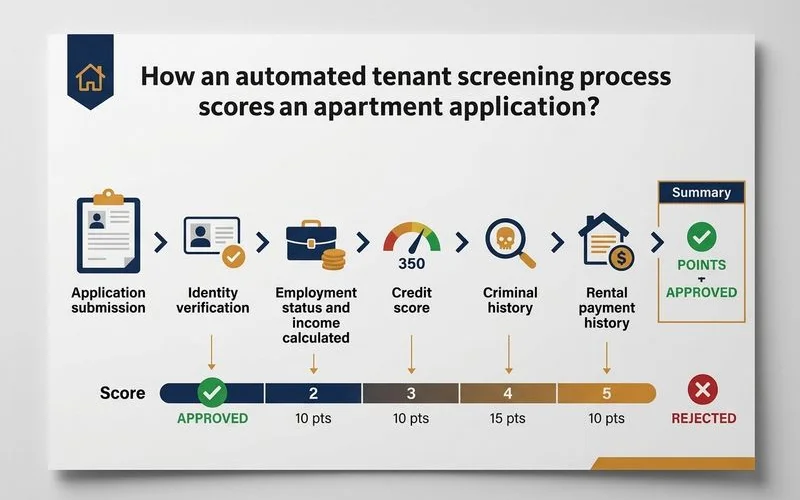
The final score depends on several strict data inputs pulled from credit bureaus and public records. Understanding exactly what these tools measure allows you to prepare a stronger application. We always advise renters to review these specific categories before applying anywhere.
- Credit data. Systems evaluate FICO or VantageScore numbers alongside open accounts, payment history, and debt-to-income ratios.
- Eviction filings. National databases catch eviction filings even if a judge dismissed the case. Travis County processed over 13,000 eviction filings in 2024 alone, meaning thousands of Austin renters face automatic algorithmic flags despite legally winning their cases in court.
- Criminal history. Tools run county-level background checks. Felonies carry a heavier penalty than misdemeanors, and the timeline of the offense heavily impacts the score.
- Rental history. Databases track your on-time versus late payments at previous apartment communities.
- Income verification. The standard Austin requirement asks for gross income equaling three times the monthly rent. The algorithms prefer standard salaried income confirmed via pay stubs, often struggling to correctly verify 1099 or gig economy earnings without tax returns.
Our leasing specialists see perfectly good applicants fail simply because of how this data is formatted. The system combines all of these isolated inputs into a single score and returns the recommendation.
Why Automated Systems Misfire
The underlying score is just a mathematical model, and mathematical models completely miss context. Automated screening frequently gives the wrong answer for a renter who would actually be an excellent resident. We constantly encounter situations where algorithmic rigidness hurts good applicants.
- Thin credit file. Young professionals or recently arrived Austin renters with limited credit history score low, even if they pay every bill on time — our guide to apartments that accept bad credit in Austin lists the buildings that weight income over a thin score.
- Old eviction filings. A 6-year-old filing that was dismissed still hits the score the same as a recent unpaid judgment in many systems.
- Self-employed income. Cash app deposits and freelance income are hard to verify automatically. The software often scores self-employed individuals lower than salaried employees for the exact same dollar amount.
- Recently improved credit. The score reflects the past 24 months or more. Recent financial improvements over the last six months are rarely captured by the algorithm.
- Misdemeanors miscategorized. Some non-violent misdemeanors get scored as if they are serious felonies.
When an Austin property uses strict algorithmic screening, these renters get auto-declined despite being perfectly stable.
How to Beat Automated Denials
You can bypass these rigid algorithms using three proven approaches focused on property targeting and file optimization. The solutions rely on applying to buildings that allow human review or strengthening the specific inputs the software measures. We categorize the solutions based on property types and application strategies.
Target Properties Allowing Human Override
Many Austin properties run the automated system first but permit a manual review when the software flags a borderline file. Interestingly, large management companies like RPM Living or Greystar often have the staff infrastructure to review files case-by-case. Older Class C properties with cheaper rent sometimes lack this staff and rely entirely on blind auto-rejections. These human-reviewed options are the exact communities our second-chance apartment locating service places clients in the most.
Strengthen the Measured Inputs
Even if you cannot change your credit score overnight, you can optimize the other metrics. You can add a third-party guarantor to substitute for a weak credit input. Paying off any outstanding balances removes the active collections penalty. Documenting income more thoroughly gives the software higher confidence in your earnings. Waiting six to twelve months after a major credit event before applying gives your score time to stabilize.
Avoid the Strictest Automated Properties
Some communities absolutely do not allow any human override. Applying there is a complete waste of your application fees if you have a single flag on your record. A simple conditional approval from systems like RentGrow might force you to pay a deposit that is 50 to 100 percent higher than standard rates. Our locator pre-screening identifies which properties use these strict rules. Deposit alternative programs like Jetty or Rhino can sometimes offset these massive conditional deposit hikes, but avoiding the strict properties altogether is the safest route.
How Properties Configure Strictness
Two different apartment buildings using the exact same SafeRent or Credit Retriever software can produce entirely different outcomes for the same renter. This variance happens because leasing managers configure their backend score thresholds and conditional rules differently. We attribute this inconsistency to localized compensating-factor policies.
One property might set the hard cutoff at a 650 credit score, while a neighboring building sets it at 580. Some leasing offices send files marked conditional to a human manager, whereas others have the system automatically reject them.
| Configuration Profile | Typical Score Cutoff | Conditional Approval Action | Override Policy |
|---|---|---|---|
| Strict Automated | 650+ | Auto-Decline | No exceptions allowed |
| Standard Review | 600 - 649 | Requires Higher Deposit | Accepts Guarantors |
| Flexible Case-by-Case | 550 - 599 | Human Manager Review | Accepts extra income proof |
You cannot tell from a property’s public website which configuration they actively use. Asking the leasing office helps, but the front desk staff often do not fully understand the algorithm parameters themselves. Our team knows that working with an experienced locator is the most effective way to find properties that match your specific file. The best strategy relies on using placement data from renters who applied before you.
The Practical Upshot
If you have a clean file with strong credit and verified income, automated tenant screening works completely in your favor for a fast approval. If you have any flag, the system will punish you for it without a chance to explain. We see automated systems automatically reject perfectly good renters every day. The fix requires choosing properties that either weigh your specific flag less heavily or allow a human manager to review the application.
This localized knowledge represents the core value of second-chance apartment locating, as the experts already know which Austin properties use human reviews. Tell us what’s on your record and the team will handle the property targeting so the automated systems never get a chance to instantly decline you.
Common Questions
Quick answers on how automated tenant screening (saferent, credit retriever) decides your application.
What is SafeRent and why was I denied?
+
Can a human override an automated denial?
+
How can I improve my screening result?
+
Related Guides
How Same-Day Apartment Approval Works in Austin
Need to move now? Learn how same-day and 24–48 hour Austin apartment approvals work, what speeds them up, and how a locator expedites the process.
What You Need Ready for a 24–48 Hour Move-In
A fast move-in only works if you're ready. Here's the exact document, deposit, and scheduling checklist to close an Austin apartment in 24–48 hours.
Ready to start your free Austin apartment search?
Tell us your situation. We'll match you only with properties that approve renters like you, free of charge.
Same-day tours • 7 days a week • 100% free for renters