Second Chance vs Traditional Apartment Search
Not sure if you need a second-chance search? Compare the two paths, see which signals point to likely denials, and learn what changes in the process.
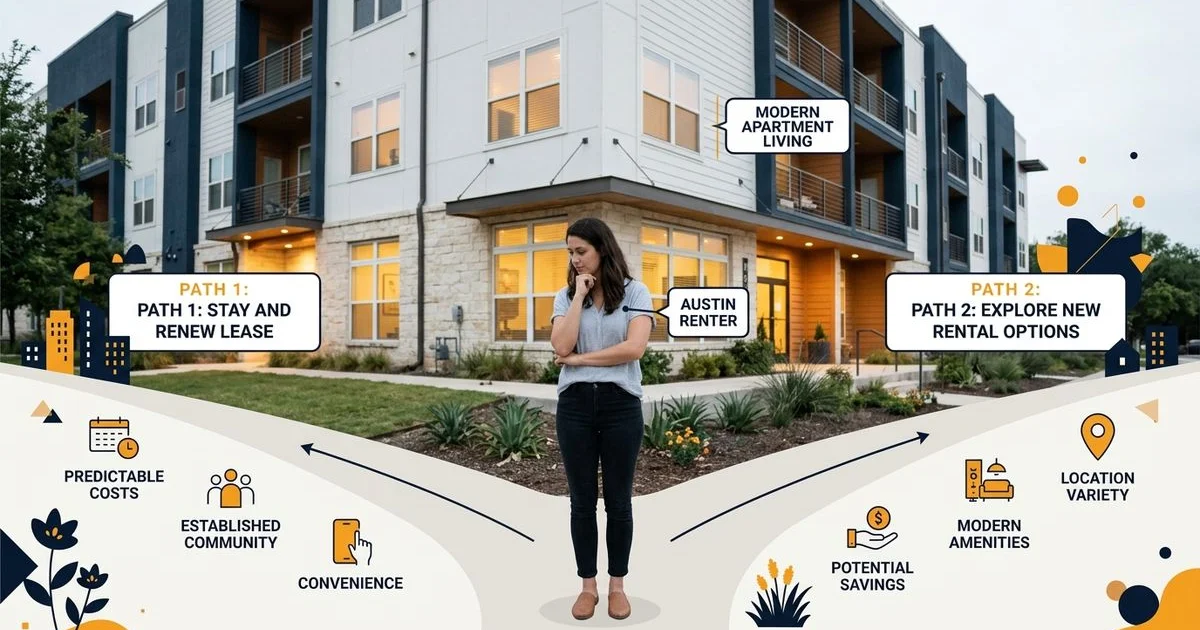
Our team regularly sees renters waste hundreds of dollars applying for apartments they have no chance of getting. You might think a single denial is just bad luck, but strict screening software rules the Austin rental market in 2026. Properties rarely make exceptions without upfront communication.
We want to help you avoid that frustrating cycle. Choosing the right path between a second chance vs traditional apartment search saves you weeks of time and a stack of non-refundable fees. Let’s look at the data to identify the exact red flags that trigger automated denials and map out a practical way to get approved.
The Quick Self-Check
Renters often ask us, do I need a second chance apartment locator? You probably need a second-chance approach if your credit falls below 600 or if you carry a broken lease on your record. A standard search will work fine if none of the major screening flags apply to you.
Our experience shows that applying to properties cold with these flags almost always results in lost application fees and rejections. You can save yourself a massive headache by reviewing this quick self-check checklist:
- Credit score under 600. Many mid-tier Austin properties use FICO Score 8 and set a hard minimum cutoff at 620.
- A broken lease. This is especially damaging if you have an outstanding balance owed to a prior landlord.
- Any eviction filing or judgment. Texas Property Code heavily favors landlords, and public eviction records trigger immediate automated denials at most properties — though eviction-friendly apartments in Austin do exist and review these records case-by-case.
- Criminal background. Any non-trivial criminal history, especially recent or felony charges, requires a case-by-case review.
- Income below the standard threshold. The standard requirement is three times the gross monthly rent. With average Austin rents hovering around $1,630 in 2026, you generally need an annual income between $58,000 and $68,000 to qualify normally.
We consider any of these issues a hard stop for traditional applications. Renters who ignore these warnings usually end up throwing money away.
How the Two Paths Differ in Practice
The traditional search optimizes for finding the exact unit you want, while the second-chance search focuses on finding the management company that will say yes. Both paths can end in a great apartment, but the execution strategy is entirely different.
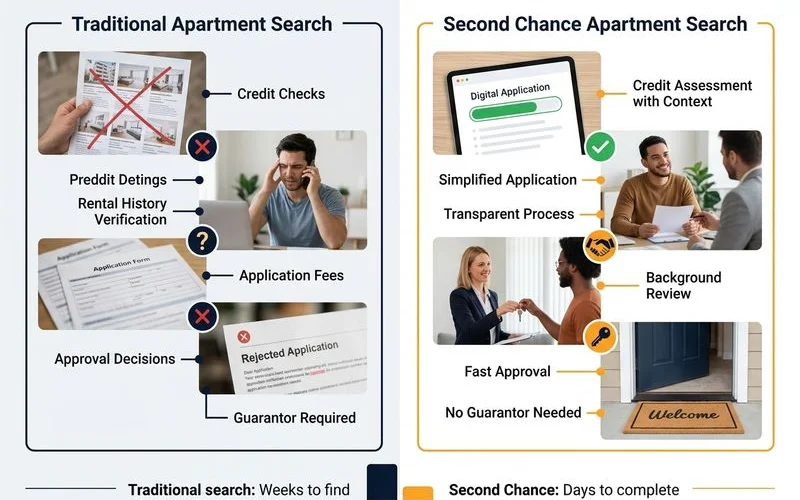
Our locators use a highly structured process for applicants with screening flags. This prevents you from blindly guessing which leasing offices might be lenient.
The Traditional Path
Traditional searches work beautifully if you have clean credit and a strong rental history. You filter by location, tour what looks good, and apply to whatever you like. You get approved almost always and move in without friction.
The Second-Chance Path
Second-chance searches require precision and upfront negotiation. You must start with your screening flags, whether that means a 580 credit score or an eviction record.
We identify which specific Austin properties will review your case based on your exact situation. The process involves pre-confirming with each leasing office that your file fits their flexible criteria before you ever submit an application.
You apply only to properties that have explicitly indicated they will review your file. Renters often pair this application with compensating factors like a paid ledger, a detailed explanation letter, a larger deposit, or a third-party guarantor. This careful preparation makes the approval rate dramatically higher per application.
| Feature | Traditional Search | Second-Chance Search |
|---|---|---|
| Primary Goal | Find the desired unit and amenities | Find the property that will approve the file |
| Application Strategy | Apply directly after touring | Apply only after management pre-confirmation |
| Approval Rate | High (with clean background) | High (due to strategic pre-screening) |
| Compensating Factors | Rarely needed | Often requires larger deposit or guarantor |
| Time to Approval | Usually 24 hours | 24 to 48 hours after finding a flexible property |
The Cost Math
This financial reality is the part most renters completely underweight. A typical Austin application attempt costs between $150 and $450 total per person.
Our local market data for 2026 shows that application fees range from $50 to $100 per applicant. Properties also charge a separate administrative fee that typically falls between $100 and $250.
If you have screening flags and apply cold to four properties, the math gets brutal very quickly:
- Best-case scenario: You get lucky on one try and lose fees on the other three. Your total cost is $450 to $1,350 in lost money.
- Common scenario: All four communities decline your application due to automated screening rules. You lose $600 to $1,800 in non-refundable fees.
If you start with a second-chance approach instead:
- Pre-screened matches: Properties are pre-confirmed to review your file.
- Higher success: The approval rate is much higher per application.
- Faster results: Most files clear within one to two applications.
We highly recommend starting with a specialized approach instead. Second-chance locating is absolutely free. The decision comes down to a small time investment to confirm your situation versus potentially burning over $1,000 in lost fees.
”Will I Get Worse Apartments If I Use Second-Chance Locating?”
The honest answer in almost all cases is no. You will not automatically get stuck with a low-quality apartment just because you need flexible approval.
Our clients are often surprised by the wide variety of properties willing to work with unique backgrounds. The case-by-case review properties in Austin span the full spectrum from outer-metro Class B complexes to mid-tier central buildings. Select luxury communities are even included in this flexible category.
These are not lesser apartments by any means. They are simply properties whose management approach is more flexible than the rigid corporate standards used by others. Many of the renters placed through this process end up in the exact same units they would have picked on their own.
“A property’s willingness to review a low credit score or a broken lease says more about their corporate structure than the quality of their amenities.”
We do see some strict limitations in very specific, high-end submarkets. The strictest luxury communities will not review case-by-case applications under any circumstances.
If living in the newest Rainey Street high-rise is non-negotiable and you have a recent eviction, finding an approval is highly unlikely. Most real-world cases are much more flexible than that extreme scenario.
When to Switch From One Path to the Other
If you get denied twice, you must switch to a second-chance approach immediately. You can still keep going on the standard path if you only have one denial, as a single rejection is sometimes just a fluke caused by unusually strict screening software.
Our data indicates that multiple denials signify a structural issue with your background check. Continuing to apply cold will not work, and you will just keep burning fees.
Here is the exact timeline for switching paths:
- After one denial: Keep trying the traditional route.
- After two denials: Stop immediately and switch strategies.
- If you know you have a screening flag: Start with a specialized locator immediately.
We advise renters to be proactive and honest about their rental history. If you have any of the major flags listed at the top of this guide, just start with second-chance apartment locating from the very beginning. This proactive choice costs you nothing upfront and skips the painful cycle of lost application fees entirely.
How to Start a Second-Chance Search
Tell us your situation in 30 seconds to get the process started. We ask the screening-flag questions plainly so the matching process is highly accurate.
The standard timeline moves incredibly fast for motivated renters. Our team ensures the next steps happen rapidly once you submit your details:
- Same-day response: You receive a verified list of properties whose criteria you actually fit.
- 48-hour touring: Most renters complete their property tours within two days of reaching out.
- Fast approvals: Property managers typically approve these pre-screened files within 24 to 48 hours.
Moving is stressful enough without adding financial risks to the equation. We find that the fee math, the speed math, and the overall success rate all heavily favor a targeted second chance apartment search austin renters rely on.
There is absolutely no reason to make the standard route harder than it needs to be.
Common Questions
Quick answers on second chance vs traditional apartment search: which is right for you.
How do I know if I need a second-chance search?
+
Is the second-chance service more expensive?
+
What changes about the process?
+
Related Guides
Apartments That Accept Bad Credit in Austin
Bad credit doesn't have to mean denial. See how credit-flexible Austin properties evaluate applicants — and how our free locators find the ones that approve you.
Apartments That Accept Broken Leases in Austin
A broken lease flag isn't the end of your search. Learn how Austin properties review broken leases case-by-case and how we match you to ones that approve.
Which Austin Apartments Accept Third-Party Guarantors
Can't qualify alone? Third-party guarantors like Liberty Rent and The Guarantors can get you approved. See which Austin properties accept them and how it works.
Ready for Second Chance?
Tell us your situation. We'll match you only with properties that approve renters like you, free of charge.
Same-day tours • 7 days a week • 100% free for renters